

A comparable sales report is a market analysis created by real estate agents using recent sales of similar properties to estimate value, while a full appraisal is a formal valuation conducted by a licensed appraiser that meets federal lending standards. The key difference: comp reports help you price and negotiate, but appraisals are required when a lender needs to verify collateral value.
Understanding when to use each—and what each actually delivers—can save you thousands of dollars and weeks. Price a listing too high because you skipped the comp research, and it sits. Underprice it, and your seller leaves money on the table. Order an appraisal when a comp report would suffice, and you've wasted $400 to $800 and two weeks of your client's patience.
This guide breaks down exactly what each document includes, what it costs, how long it takes, and which situations call for which approach. If you work with land, rural property, or anything outside cookie-cutter subdivisions, pay close attention—the gap between these two tools gets wider when parcels get bigger.
What Is a Comparable Sales Report?
A comparable sales report (also called a comp report or CMA—comparative market analysis) is a document that estimates a property's market value by analyzing recent sales of similar properties nearby. Real estate agents, brokers, and investors create comp reports to support pricing decisions, listing presentations, and purchase negotiations.
What's Included in a Typical Comparable Sales Report
A well-prepared comp report contains:
- Subject property details: address, size, acreage, property type, and key features
- 3–10 comparable sales: recently sold properties with similar characteristics
- Sale prices and dates: what each comp actually sold for and when
- Adjustments: dollar-value adjustments for differences between the subject and each comp (e.g., +$15,000 for an extra bedroom, -$8,000 for a smaller lot)
- Estimated value range: the suggested price based on adjusted comp data
- Map or aerial view: showing comp locations relative to the subject property
The best comp reports also include price-per-square-foot or price-per-acre calculations, days-on-market data for active listings, and notes explaining why each comp was selected.
Who Creates Comparable Sales Reports
Unlike appraisals, comp reports don't require a license. Real estate agents create them for clients, investors build them for internal decision-making, and some property data platforms generate them automatically.
Cost & Timeline
Most agents provide comp reports free as part of their listing services. If you hire someone specifically for a comp report, expect to pay $50 to $150. Timeline: a thorough manual comp report takes 1–3 hours; automated tools can generate one in minutes.
What Is a Full Appraisal?
A full appraisal is a formal, legally defensible opinion of value prepared by a state-licensed or certified appraiser. Appraisals follow standards set by the Uniform Standards of Professional Appraisal Practice (USPAP) and are required by federal regulations whenever a lender needs to verify the value of collateral for a mortgage.
What's Included in a Full Appraisal
A residential appraisal report typically includes:
- Property inspection: the appraiser visits the property, measures it, photographs the interior and exterior, and notes its condition
- Comparable sales analysis: similar to a comp report, but with rigorous documentation standards
- Three valuation approaches: most appraisals use the sales comparison approach, but may also include the cost approach (replacement cost minus depreciation) and income approach (for investment properties)
- Neighborhood analysis: assessment of market trends, zoning, and external factors affecting value
- Final opinion of value: a single dollar figure that the appraiser certifies as the property's market value as of a specific date
- Appraiser certification: a signed statement that the appraiser has no financial interest in the transaction and follows USPAP standards
Who Creates Appraisals
Only licensed or certified appraisers can prepare appraisals for federally related transactions. Appraisers must complete education requirements, pass state exams, and log supervised experience hours. For complex properties—commercial buildings, large land parcels, or high-value estates—lenders often require a certified general appraiser rather than a licensed residential appraiser.
Cost & Timeline
Residential appraisals typically cost $400 to $800, depending on property type and location. Rural or land appraisals often run $600 to $1,500+ due to complexity. Timeline: expect 7–14 days from order to delivery, though high-demand markets may stretch to three weeks.
Comparable Sales Report vs. Full Appraisal: Key Differences
Comparable Sales Report
Best for quick property research, pricing, and negotiation.
- Created by: Real estate agents, investors, or automated tools
- Inspection: Usually not required
- Turnaround: Minutes to hours
- Cost: Free to around $150
- Valuation: Based on comparable sales
- Legal standing: Informal market analysis
- Lender use: Not accepted for mortgage underwriting
- Regulation: Not subject to appraisal licensing or USPAP standards
Full Appraisal
Best for lending, legal proceedings, estates, and other formal valuations.
- Created by: A licensed or certified appraiser
- Inspection: Typically includes an in-person property inspection
- Turnaround: Usually 7–21 days
- Cost: Around $400–$1,500+
- Valuation: May use sales comparison, cost, and income approaches
- Legal standing: Formal, legally defensible valuation
- Lender use: Required for many mortgage transactions
- Regulation: Governed by professional standards and state licensing
The Credibility Gap
A comp report reflects the preparer's opinion—useful, but not independently verified. An appraisal carries the weight of professional certification, E&O insurance, and regulatory oversight. That's why lenders won't accept a comp report in place of an appraisal: they need an independent third party with no stake in the transaction.
The Flexibility Gap
Appraisers follow strict methodologies. They can't skip steps or ignore data that doesn't support a desired value. Agents creating comp reports have more flexibility—they can emphasize the comps that best support their client's position, exclude outliers with reasonable justification, and adjust their analysis as negotiations evolve.
This flexibility is a feature, not a bug. Pricing a listing isn't the same as certifying value for a lender. But it also means comp reports require critical evaluation—whoever created the report had an agenda, even if that agenda is simply "help my client."
When to Use a Comparable Sales Report
Comp reports are the right tool when you need speed, flexibility, and cost-efficiency—and when no lender or court is demanding formal documentation.
Listing Presentations
You're meeting a seller tomorrow. They want to know what their property is worth. A comp report with recent sales, aerial imagery, and a clear price range makes you look prepared and credible. It's also the foundation for the pricing conversation that wins or loses the listing.
Initial Pricing Decisions
Before you list, you need a number. Comp reports let you test pricing strategies, identify the competitive set, and spot potential issues (like a neighbor who sold at a distressed price that buyers will cite in negotiations).
Buyer Negotiations
Your buyer wants to offer $50,000 below asking. A comp report showing that similar properties sold for less gives them ammunition—and gives the seller's agent a face-saving way to recommend acceptance.
Off-Market Acquisitions
Investors and developers approaching owners directly need a defensible offer price. A comp report provides the data foundation: "Your neighbors at 4521 Ranch Road sold for $X per acre last year. Here's what I'm prepared to offer."
Land & Rural Properties
This is where comp reports often matter most—and where they're hardest to create. MLS data is sparse for rural parcels. County records may be your only source. If you work land deals, the ability to pull comps quickly isn't optional—it's how you compete with agents who specialize in your market.
When to Use a Full Appraisal
Appraisals are required—or strongly advisable—when formal valuation documentation matters more than speed or cost.
Mortgage Financing
Federal regulations require appraisals for most residential mortgages. No appraisal, no loan. The lender orders the appraisal, selects the appraiser (via an appraisal management company in most cases), and pays for it—though the cost is typically passed to the borrower.
Estate Settlements
When someone dies, their estate needs accurate valuations for tax purposes and equitable distribution. The IRS expects appraisals, not comp reports, when significant real property is involved.
Divorce Proceedings
Courts dividing marital assets require impartial valuations. An appraisal from a neutral third party carries weight that a comp report from one spouse's real estate agent never will.
Legal Disputes
Property tax appeals, boundary disputes, eminent domain cases, and breach-of-contract litigation all demand formal appraisals. A comp report won't survive cross-examination; an appraisal might.
High-Value Transactions
Even when not legally required, sophisticated buyers and sellers often order appraisals for transactions above $1 million. The cost is trivial relative to the stakes, and the independent validation reduces deal risk for both parties.
Can a Comparable Sales Report Replace an Appraisal?
Short answer: No, not when a lender or court requires a formal valuation.
Comp reports and appraisals serve different purposes.
- A comp report is a market analysis tool—it helps you make decisions.
- An appraisal is a legal document—it proves value to third parties with authority over the transaction.
When a Comparable Sales Report Is Sufficient
- Cash purchases with no lender involved
- Pricing decisions and listing strategies
- Initial due diligence before committing to a purchase contract
- Internal investment committee presentations
- Owner outreach for off-market acquisitions
When Only an Appraisal Will Do
- Any federally related mortgage loan
- SBA loans and most commercial financing
- IRS documentation for estate or gift tax purposes
- Court-ordered valuations
- Transactions where one party's attorney demands formal documentation
The Hybrid Approach
Smart agents use comp reports to prepare for appraisals—not to replace them. If you've already identified the best comps and understand the subject property's position in the market, you can anticipate what the appraiser will find. That means fewer surprises, faster closings, and clients who trust your expertise.
How to Use Land id® to Make Comparable Sales Reports Faster
Pulling comps manually means toggling between your MLS, county records, software platforms, and a spreadsheet where you're trying to keep it all straight. For rural and land properties—where MLS coverage is thin and parcels vary wildly—this process can eat an entire afternoon.
Land id's Comparable Sales Report feature changes that workflow.
One-Click Reports from the Parcel Card
Land id Pro users:
- Click on any parcel in Land id.
- Open the parcel card.
- Generate a comparable sales report.
- Filter for the most relevant comps.
That’s it.
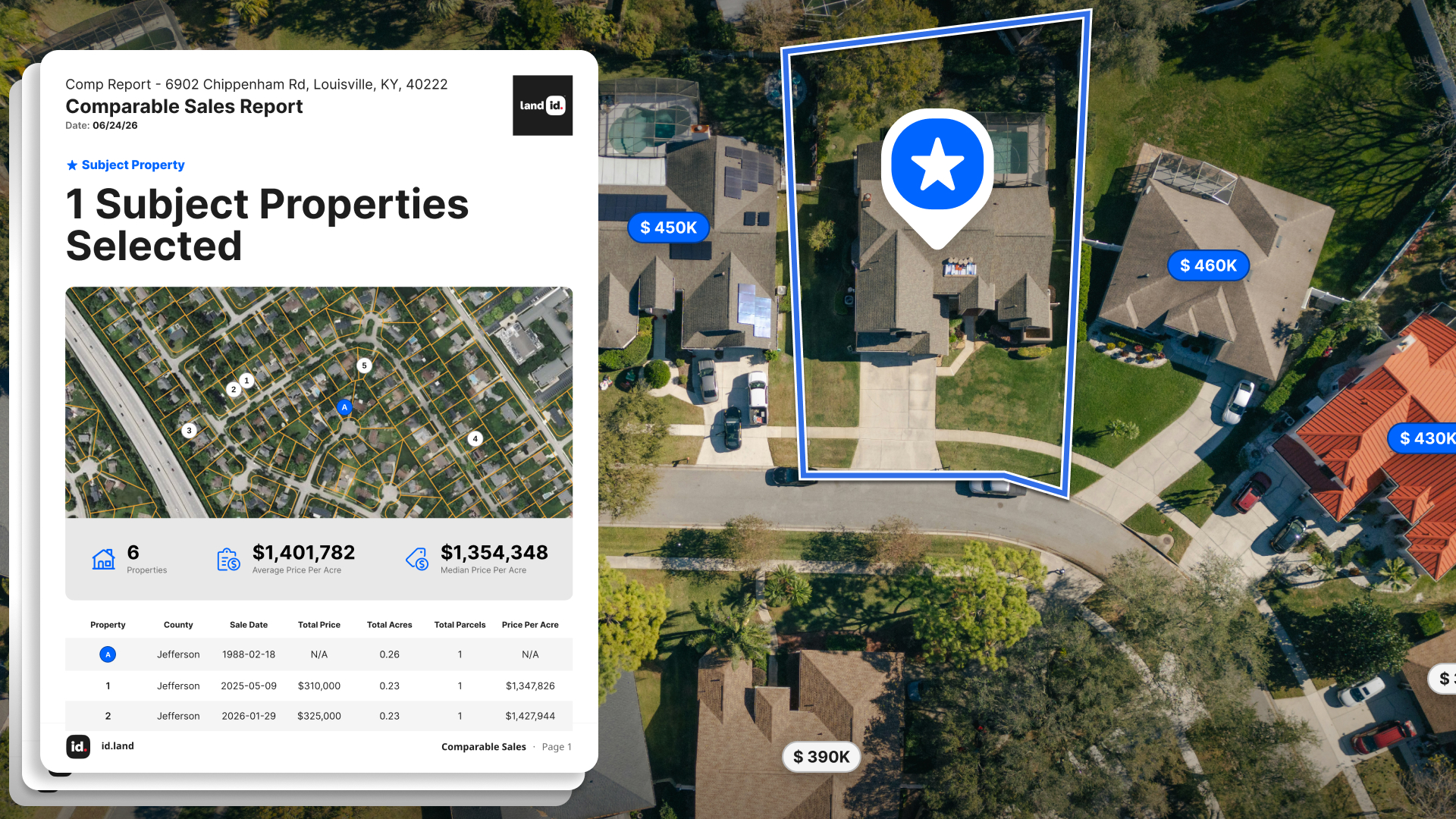
Land id can automatically filter for recent sales with similar characteristics—property type, acreage, location—and compiles them into a professional PDF.
You can also manually filter by acreage, sale date, land use, and vacant land to deliver even more accurate results.
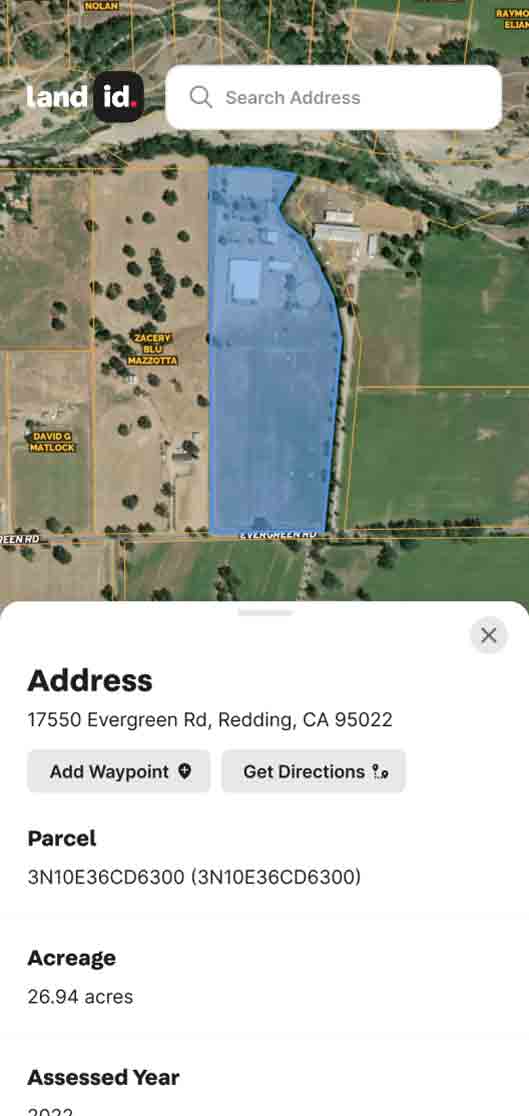
Comparable sales reports are also available on mobile with automated, limited filtering.
Map View With Spatial Context
Comparable sales aren't just numbers—location matters. Land id displays comparable sales on a map, so you can see exactly where each comp sits relative to your subject property. That context helps you explain adjustments to clients: "This comp sold for more because it's on a paved road with highway frontage. Your property has better views but a longer driveway."
Professional PDF Output
The finished report includes aerial imagery, sale prices, parcel details, and your branding. Hand it to a client, attach it to a listing presentation, or use it as the foundation for an offer letter. No more copy-paste assembly in Word.
See an example Land id comparable sales report
Ideal for Land & Rural Properties
Land id comparable sales reports are excellent for properties that don't fit neatly into MLS databases, such as ranches, farms, recreational tracts, rural residential, and development parcels. That's exactly where comp research is hardest and where automated tools deliver the most value.
FAQs
Does Land id have comparable sales reports?
What's the difference between a CMA and a comp report?
How much does a full appraisal cost?
How long does a comparable sales report take compared to an appraisal?
Do lenders accept comparable sales reports instead of appraisals?
How many comps should a comparable sales report include?
What if there are no recent comparable sales in my area?
Pull Comparable Sales In One Place
Search comparable sales and create reports in-platform, or build and track your own proprietary comps database. Great for complex properties. Try for free!

Continue Reading
Feature Drops: Contact Information, AI Insights, CarPlay on All Plans & More

By Land id
From contact info to AI-powered property insights to more tools on mobile, here's what's new in Land id—and how these updates make your work easier.

The Different Types of Easements & How They Work
By Land id
Learn the definition of an easement, the different types of easements in real estate, how they affect property rights and value, and how to check for easements before buying property.


Explore Private Parcel Data & Property Boundaries
Download the Land id app and try for free.