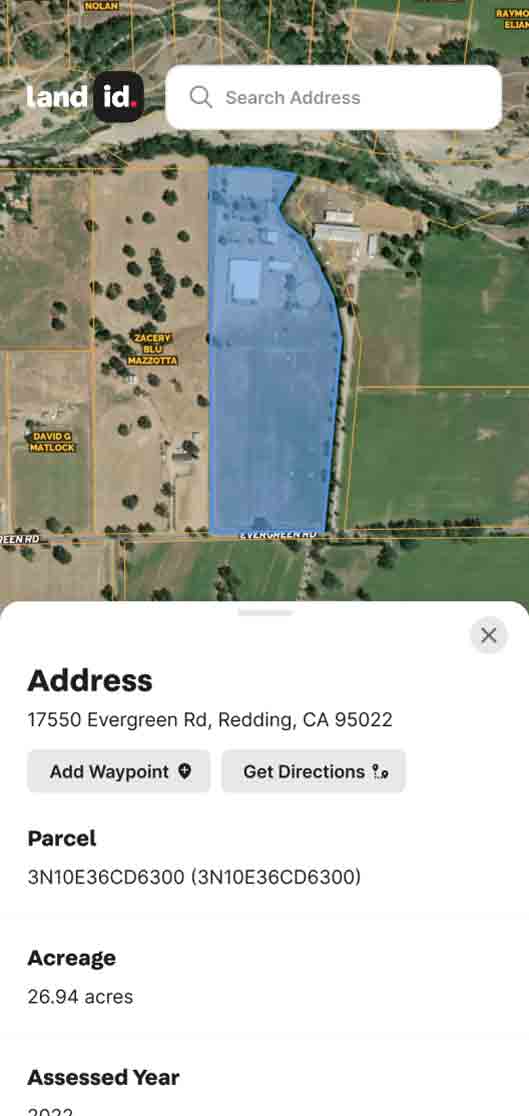


An absentee owner list is a database of property owners whose mailing address differs from the property address—meaning they don't live at the property they own.
These lists are among the highest-converting lead sources in real estate because absentee owners are often more motivated to sell: they're managing properties from a distance, paying carrying costs on homes they don't use, and may be less emotionally attached to the asset.
What Is an Absentee Owner?
An absentee owner is anyone who owns a property but doesn't live there. The owner's mailing address on file with the county is different from the property's physical address.
Examples of absentee property owners include:
- Out-of-state landlords managing rental properties remotely.
- Inherited property owners who received a home through probate but live elsewhere.
- Vacation homeowners with second homes they rarely visit.
- Accidental landlords who moved but couldn't sell their previous home.
- Investors holding properties in markets far from where they live.
Why Absentee Owner Leads Are More Likely to Sell
Lower Emotional Attachment
When you live in a home, it's not just an asset—it's where you raised your kids, hosted holidays, and built memories. Absentee owners may not have that baggage. For some, the property is a line item on a balance sheet, not a chapter of their life.
Related: Prospecting Part I: Finding More Seller Leads
Carrying Costs Create Pressure
Every month, an absentee owner writes checks for property taxes, insurance, HOA fees, and maintenance. That financial friction compounds over time.
Management Headaches
Managing a property from potentially hundreds of miles away is exhausting. Many absentee owners reach a point where the hassle outweighs the investment thesis.
Life Changes Accelerate Decisions
Divorce, retirement, job relocation, layoffs, or a new baby can shift priorities fast.
They're Unaware of Local Market Value
Absentee owners aren't watching the property’s local market the way owner-occupants do. When you reach out with accurate market data, you're often delivering news they didn't know—and creating an opportunity they hadn't considered.
How to Find Absentee Owners Using a Land id Mailing List
Owner mailing lists are available in Land id for an additional per-line fee. When you purchase a list, you can filter the results to surface absentee owners. Here’s how to do it:
- Define Your Search Area—Draw a boundary around your target neighborhood, landmark, city, county, etc.
- Apply Your Filters—Use Land id's filter criteria to narrow your list by acreage, assessed value, sale date, and property type (single-family, vacant, or agricultural).
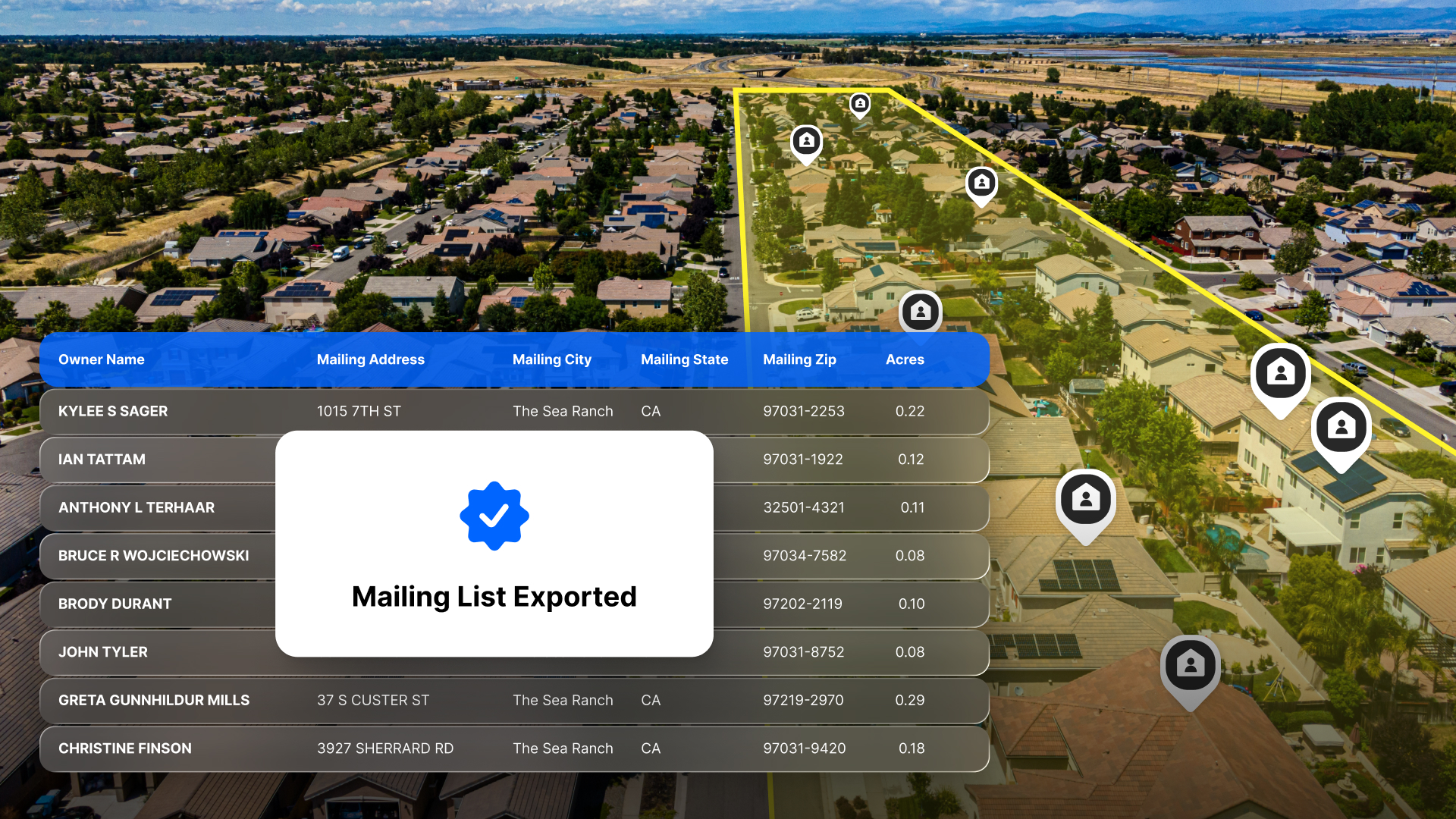
- Export to CSV—Download your automatically deduplicated list with owner names, mailing addresses, property details, and additional data fields. (Note: This is an additional cost per line in Land id. The checkout process will clearly indicate the cost so you can review and adjust the list according to your budget, if needed.)
- Filter for signals of absentee ownership—In your CSV, look for sale dates of 10+ years prior and properties where the owner’s mailing address differs from the property address.
Example: Build a list of owners around a recreational lake surrounded by vacation properties. Look for owners whose mailing address doesn’t match the property address and whose sale date was 10+ years ago. These are absentee owners who may be more interested in selling.
Related: Prospecting Part II: Find Off-Market Properties
Common Mistakes When Using Absentee Property Owner Lists
Casting Too Wide a Net
Mailing every absentee owner in a ZIP code is expensive and ineffective. Filtering aggressively can push response rates to 2–3% or higher.
Ignoring Data Freshness
Stale data means wrong addresses, deceased owners, and properties that have already sold.
Using Generic Messaging
Personalized messaging that references specific property details gets opened. Your list gives you data; use it to tailor messaging.
Giving Up After One Outreach
Consistent follow-up over 6–12 months is what separates agents who generate listings from agents who complain that "direct mail doesn't work."
Forgetting to Exclude Recent Sales
Properties that sold in the last 12 months are unlikely to sell again soon.
Conclusion
Absentee owner lists are one of the most reliable ways to find off-market opportunities before your competition does. The key isn't just having a list—it's having a targeted list filtered by the criteria that actually predict motivation.
Land id gives you the filters, the data, and the export tools at an affordable per-line price to build absentee owner lists that convert.
Ready to build your first targeted list? Start your free Land id trial and surface absentee owner lead opportunities today.
FAQs
How do I create mailing lists in Land id for prospecting?
What information is included in Land id’s owner mailing lists?
Do owner mailing lists cost extra?
Is it legal to buy and use absentee owner lists?
What's the difference between an absentee owner and a non-owner occupant?
See Land id In Action
Research, analyze, share, and showcase real estate, all in one place.
Continue Reading
Feature Drops: Contact Information, AI Insights, CarPlay on All Plans & More

By Land id
From contact info to AI-powered property insights to more tools on mobile, here's what's new in Land id—and how these updates make your work easier.
Would You Buy These 5 Horror Movie Houses?
By Land id
We looked at five famous houses in Halloween movie history through a Land id lens to see what the buyer should have known—if only someone had told them.

Explore Private Parcel Data & Property Boundaries
Download the Land id app and try for free.